
Swinburne’s Spotlight on STEM: A Night of Space Innovation with Shelli Brunswick

In summary
Swinburne University hosted a Spotlight on STEM event with space innovator Shelli Brunswick, exploring space technology, leadership, and career opportunities in the space industry
Supported by the U.S. Consulate Melbourne, Shelli Brunswick shared her journey from US Air Force space acquisition officer to COO of the Space Foundation
Shelli Brunswick and Swinburne’s Dr Sara Webb discussed the role of space in daily life, actionable leadership, the importance of failing and the emerging intersections of space with technologies like biotech and robotics
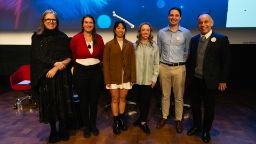
Swinburne University of Technology has hosted a captivating Spotlight on STEM event, featuring Shelli Brunswick, a distinguished leader in space innovation. The evening brought together space enthusiasts, students, and industry professionals for an inspiring conversation on space technology, actionable leadership, and space-related career opportunities.
Shelli Brunswick, a former US Air Force officer and Chief Operating Officer of the Space Foundation, has experience in both the commercial and government sectors. Known for her advocacy of space technology and contributions to global space exploration, she has collaborated with organisations such as NASA, the European Space Agency (ESA), and many others.
Joined by Swinburne astrophysicist and lecturer Dr Sara Webb, Ms Brunswick discussed the importance of fostering a successful space landscape. The conversation explored how space impacts our daily lives, space tradies, actionable leadership, why failing matters and the importance of collaboration between countries.
How the space industry drives innovation, education and careers
Space plays a significant role in our daily lives, often in ways we don’t realise. Innovations from the US Apollo space program in the 1960s, like telecommunications, have enabled advancements such as remote work and telehealth. Today, emerging technologies such as robotics, biotech, and advanced manufacturing all intersect with space.
Ms Brunswick described space-led tech translation in healthcare, for example, with the potential for 3D printing aboard the International Space Station to treat macular degeneration.
“In the US, Dr Nicole Wagner’s work with Lambda Vision is innovating here. It’s easier to print that material in space, and we hope to see trials in the next few years.”
Since the Apollo era, when space was largely government-driven, commercial companies are now the key players. Ms Brunswick and Dr Webb discussed the various jobs needed in the space industry, from electricians and machinists, to STEM professionals and marketers, and how all roles are equally important.
“In the US we need all those jobs filled, from rocket scientist all the way to the supply chain and everything in between. Australia has a fantastic space industry with military, civil, commercial and even non-government agencies, so the need for everyone to find their place is available,” said Ms Brunswick.
The pair discussed how tertiary education and vocational education will offer critical support to the global space industry, upskilling students for a sector forecast to grow to over USD $1.1 trillion by 2040.
Young people entering the space industry face several barriers, such as the perception that space careers are only for astronauts and rocket scientists. The panelists encouraged those interested in space sector careers to try out opportunities that are outside your comfort zone – not just in space, but in STEM, too.
Ms Brunswick challenged teachers, parents and business leaders to engage the next generation of space professionals by taking them to space centers, being a judge at a science fair, inviting a school group to visit your space company, or even something as simple as stargazing.

The role of collaboration and entrepreneurship in the space industry
Ms Brunswick explained the importance of collaboration in creating a successful space industry. Reflecting on NASA's Project Artemis, and Australia’s role with our upcoming lunar rover mission called ‘Roo-ver), Ms Brunswick said, “Who better to ask to help us figure out how we mitigate dust, or how we drill on the moon, than a country that has successful mining operations?”
Ms Brunswick also highlighted the work of space entrepreneurs who are developing groundbreaking solutions. One solution relates to how we can turn space junk into a valuable resource.
Among the latest innovations are debris-catching nets designed to remove space junk, and new methods to repurpose and re-manufacture old equipment in orbit, which help to keep space stations and satellites safe. Ms Brunswick highlighted Australian entrepreneur Daniel Faber, whose company, Orbit Fab, is pioneering the concept of space-based ‘gas stations’.
Swinburne’s Spotlight on STEM event provided a rare opportunity to engage with one of the most influential figures in the global space community.
“It was enlightening to hear Shelli’s insights around the space industry and how we are all responsible for shaping its future,” says Dr Webb.
“I had a powerful day with Shelli across multiple events, and each left the audience engaged and inspired for what’s to come in space.”
-
Media Enquiries
Media Enquiries
Related articles
-
World-first psilocin binge eating disorder trial reveals improvement in all patients

- Science
Swinburne University of Technology and Entropy Neurodynamics’ world-first IV-infused psilocin binge eating disorder trial has led to improvement in all participants.
Tuesday 15 September 2026 -
We must seed discoveries for a strong nation

- Science
This National Science Week, Swinburne’s Chief Scientist is calling on the federal government to rethink our investment in science as a matter of global importance.
Wednesday 19 August 2026 -
Swinburne joins global biomaterials research training program

- Technology
- Health
- Science
- University
- Engineering
Swinburne has joined the prestigious German Research Foundation-funded International Research Training Group (IRTG) on Multidimensional Biomaterials (MB)2 program
Monday 17 August 2026 -
Swinburne celebrates the seeds of discovery for National Science Week
- Science
- University
- Technology
Swinburne celebrated National Science Week 2026, culminating with the Seeds of Science Festival, held on 21 August. The festival showcased the people, research and ideas shaping the future of science and innovation.
Friday 21 August 2026 -
Rare ultra-magnetic star the key to solving a quantum cold case

- Astronomy
A Swinburne astronomer may have just confirmed one of the quirkiest aspects of quantum mechanics: that seemingly empty space can alter the behaviour of light.
Thursday 06 August 2026