
Swinburne’s international collaborations driving meaningful impact

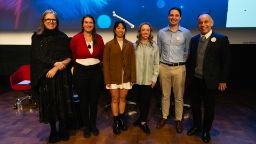
(L-R) Dr Anggito Tetuko, Dr Agung Setiawan and Dr Bakti Sedayu spent time at Swinburne's Hawthorn campus working with our researchers to tackle global challenges in clean energy, sustainable materials and energy-efficient buildings
In summary
Swinburne is collaborating with international researchers to tackle global challenges in clean energy, sustainable materials and energy-efficient buildings
Three researchers from Indonesia joined Swinburne’s Hawthorn campus through the International Education Innovation Fund
Their projects explored rare earth elements for clean technologies, phase-change materials to reduce energy consumption in buildings and creating seaweed-based bioplastics for sustainable packaging
Swinburne University of Technology recently hosted three international researchers, Dr Agung Setiawan, Dr Anggito Tetuko and Dr Bakti Sedayu from Indonesia under the International Education Innovation Fund program funded by the Department of Education.
These researchers were based at Swinburne’s Hawthorn campus, where they worked with Swinburne researchers on various sustainability projects.
“Swinburne’s commitment to international collaboration is at the heart of our research and innovation,” says Swinburne’s Pro-Vice Chancellor, Flagship Initiatives, Professor Alan Duffy.
“Our collaborations with leading researchers from the Indonesian National Research and Innovation Agency (BRIN) expands our horizons and drives meaningful impact across our shared priority areas, including advanced materials, sustainable infrastructure, bioplastics and energy transitions.”
“These collaborations foster valuable international experience, strengthen professional networks and accelerate research innovation that benefits Australia and our ASEAN partners. The world truly is our campus, and we are proud to continue building bridges with our international colleagues to address global challenges,” Professor Duffy says.
Driving innovation in rare earth elements processing
Dr Agung Setiawan specialises in minerals processing and sustainable metallurgy. During his time at Swinburne, he worked with Professor Akbar Rhamdhani and Dr Dani Rhamdhani on the dephosphorisation of rare earth-bearing monazie through biomass-based carbothermic treatment. This project also involved the team collaborating with Dr Mark Pownceby from CSIRO Mineral Resources.
“Developing more sustainable methods for processing rare earth minerals is important for securing future critical mineral supply. Innovative approaches to remove impurities such as phosphorus can improve extraction efficiency while reducing environmental impact,” says Dr Setiawan.
This will help improve extraction and processing methods, supporting Australia's efforts to secure critical materials, reduce reliance on imports, and contribute to the development of advanced, low-carbon manufacturing processes.
Reducing energy consumption
Dr Anggito Tetuko specialises in thermal management and storage. He collaborated with Professor Rhamdhani and Dr Md Morshed Alam on the modelling of phase change materials encapsulated in concrete.
“Phase change materials can absorb, store and release substantial thermal energy by transitioning between solid and liquid phases while maintaining a near constant temperature,” says Dr Tetuko.
This research is significant as the unique property of phase change materials can be integrated into walls, concretes and ceilings, which could improve thermal management in buildings.
These materials help maintain stable indoor temperatures and reduce the demand for heating and cooling, leading to lower energy consumption for households and businesses.
Developing durable bioplastics
Dr Bakti Sedayu specialises in marine and fisheries postharvest. While at Swinburne, he collaborated with Professor Paul Stoddart on enhancing the properties of seaweed-derived bioplastic good packaging using cold plasma irradiation.
“Seaweed-derived bioplastics are regarded as more sustainable for development given their natural abundance and avoidance of price competition with food commodities. Thus, these seaweed-derived bioplastic products could help address environmental problems caused by conventional plastics,” explains Dr Sedayu.
This project addresses key challenges in the adoption of seaweed-derived bioplastics in food packaging, specifically their high-water sensitivity and poor mechanical strength. It explores the used of cold plasma irradiation to make bioplastics more durable and suitable for practical applications, which could support Australia’s transition to sustainable materials and manufacturing.
-
Media Enquiries
Media Enquiries
Related articles
-
World-first psilocin binge eating disorder trial reveals improvement in all patients

- Science
Swinburne University of Technology and Entropy Neurodynamics’ world-first IV-infused psilocin binge eating disorder trial has led to improvement in all participants.
Tuesday 15 September 2026 -
We must seed discoveries for a strong nation

- Science
This National Science Week, Swinburne’s Chief Scientist is calling on the federal government to rethink our investment in science as a matter of global importance.
Wednesday 19 August 2026 -
Swinburne joins global biomaterials research training program

- Technology
- Health
- Science
- University
- Engineering
Swinburne has joined the prestigious German Research Foundation-funded International Research Training Group (IRTG) on Multidimensional Biomaterials (MB)2 program
Monday 17 August 2026 -
Swinburne celebrates the seeds of discovery for National Science Week
- Science
- University
- Technology
Swinburne celebrated National Science Week 2026, culminating with the Seeds of Science Festival, held on 21 August. The festival showcased the people, research and ideas shaping the future of science and innovation.
Friday 21 August 2026 -
Planting the seeds for future space scientists

- Astronomy
- Education
- Business
- Science
A Swinburne spinout LaunchLabz, is inspiring the next generation of space scientists with their Mission Kits
Monday 17 August 2026