
Swinburne's Social Innovation Institute backs projects on circular economy, ancestry and critical care nursing

Nurse reading a patient’s notes
In summary
Swinburne’s Social Innovation Research Institute has granted seed funding to three new research projects
The projects will provide critical research in the areas of AI in circular consumption behaviour, critical care nursing and uncovering Wamba Wemba ancestral connections
Three Swinburne research projects have received seed funding from the Social Innovation Research Institute which helps support and co-create solutions to complex social problems.
The role of generative AI in facilitating circular consumption behaviour
Generative Artificial Intelligence (AI) could play an important role in encouraging sustainable consumption behaviour. Circular consumption is an important part of the broader concept of a circular economy, which aims to eliminate waste and the continual use of resources. Increasing circular consumption is critical, given the need to address environmental challenges, ensure resource sustainability and promote economic resilience in the face of climate triggered resource scarcity.
Led by consumer behaviour expert, Dr Carla Ferraro, this project will explore the barriers, facilitators and the role of AI in enabling circular behaviours. Dr Ferraro stresses the importance of doing this through a consumer behaviour and social psychology lens.
“One of the critical barriers to circular consumption is current consumer culture which centres on newness and disposability. Shifting consumer mindsets towards valuing longevity, repairability and sustainability is crucial, as is motivating them to consume in this way. We’re interested in what chatbots can do in forming these new habits.”
Preparing for artificial intelligence in critical care nursing
AI is gaining traction in Australian healthcare and will increasingly be incorporated into the nursing profession. In critical care units, AI is set to play a dominant role in decision-making based on its ability to predict things like length of stay, discharge readiness, readmission likelihood and mortality rates.
However, AI also brings certain risks and challenges such as over – or under – reliance and distrust of AI systems. Managing these opportunities and risks will require training and education of critical care nurses. Such training will need to be tailored to current levels of use, knowledge and attitudes of nurses towards AI.
A team of researchers from Swinburne are conducting research to help prepare nurses for the increasing use of AI in nursing practice.
Lead researcher and social psychologist, Dr Julian Oldmeadow emphasises the importance of gaining insights into the impacts of AI in nursing practice and the attitudes of nurses towards it.
“Ultimately, the study will help the nursing profession to manage the opportunities and risks associated with increasing use of AI and identify areas where further training of nurses could best be targeted.”
Uncovering Wamba Wemba ancestral connections
Another project, led by Professor Dean Lusher, will see Swinburne partner with Wamba Wemba Aboriginal Corporation on a study of written colonial records, as part of an exploration of Wamba Wemba ancestral connections.
The project will use social network mapping technologies to visualise relationships for the community. Professor Lusher is an accomplished social network researcher and proud Wamba Wemba man.
-
Media Enquiries
Media Enquiries
Related articles
-
New Swinburne co-led consortium to accelerate research translation and innovation
- University
Swinburne is helping accelerate research translation through the newly launched Australian Research Translation and Innovation Consortium (ARTIC)
Tuesday 04 August 2026 -
Swinburne joins global biomaterials research training program

- Technology
- Health
- Science
- University
- Engineering
Swinburne has joined the prestigious German Research Foundation-funded International Research Training Group (IRTG) on Multidimensional Biomaterials (MB)2 program
Monday 17 August 2026 -
Planting the seeds for future space scientists

- Astronomy
- Education
- Business
- Science
A Swinburne spinout LaunchLabz, is inspiring the next generation of space scientists with their Mission Kits
Monday 17 August 2026 -
Celebrating Swinburne’s next generation of researchers
- Technology
- Health
- Education
- Business
- Science
- Sustainability
- Engineering
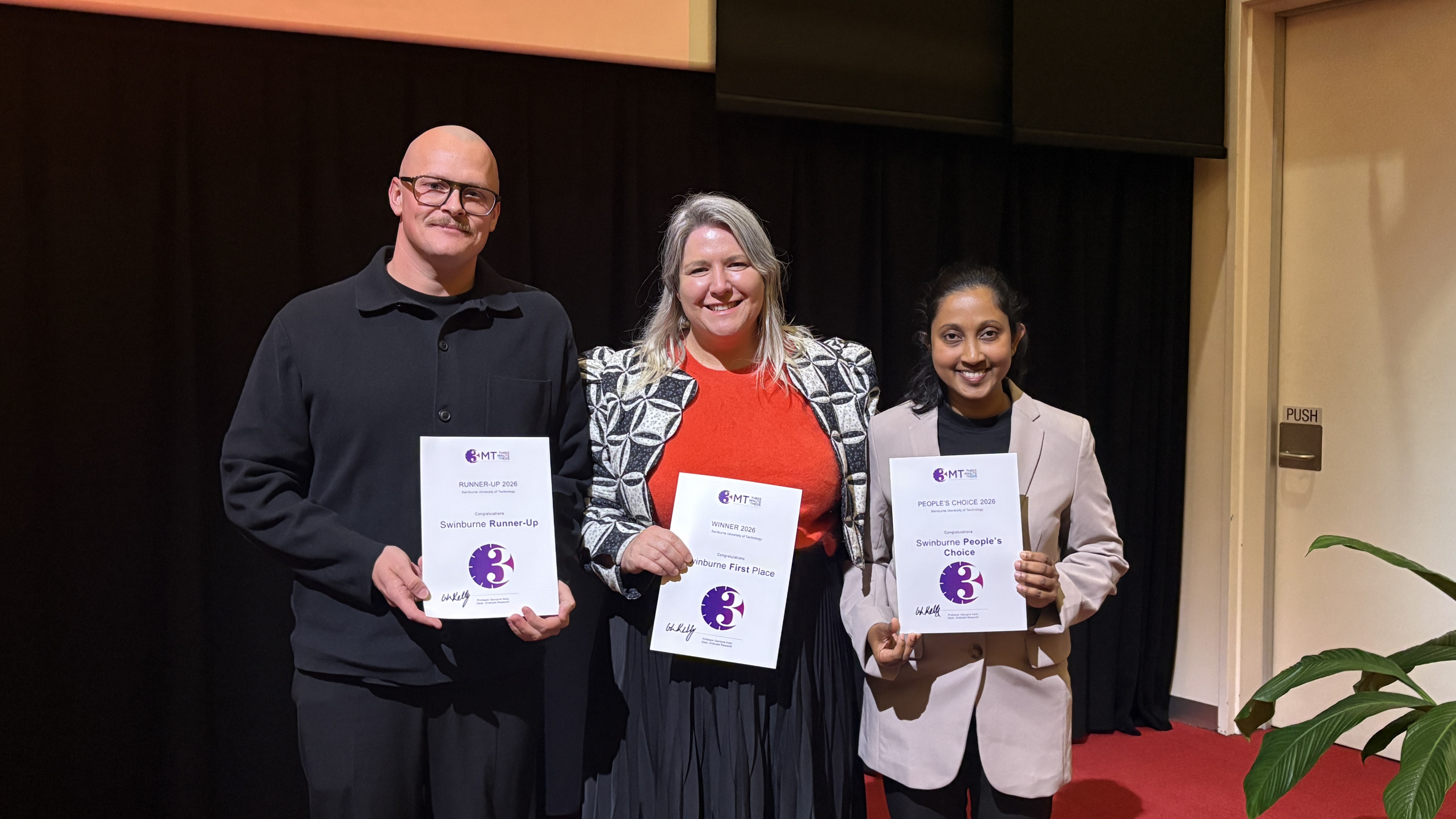
Swinburne’s inaugural Research Festival brought together Higher Degree by Research students and early career researchers to learn, share and connect.
Monday 27 July 2026 -
Swinburne and Geotab to advance AI-powered transport innovation and research
- Technology
- Education
- Science
- University
The Geotab-Swinburne Transport Innovation Hub will connect industry professionals, policymakers and researchers to translate insights into solutions.
Wednesday 03 June 2026